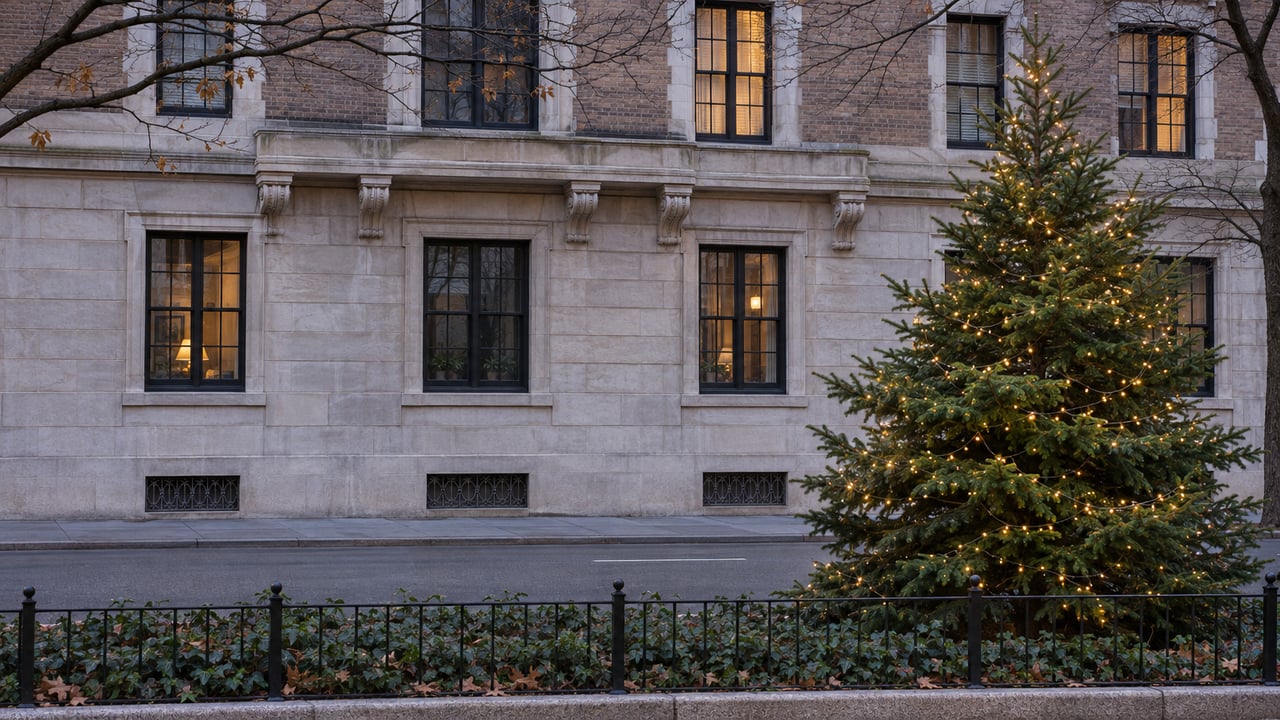
At 6 p.m. on Thursday, Dec. 3, a crowd will gather at Park Avenue and East 38th Street for the Murray Hill Neighborhood Association's annual Holiday Party & Tree Lighting. The next evening at 5:30, three blocks south at Park Avenue and East 35th Street, Metropolitan Synagogue lights its public menorah on the first night of Hanukkah.
The two lightings are three blocks and one day apart, and both happen on ground that Murray Hill's own history built. The landscaped malls exist because of a railroad. The tree lighting marks something invented a few doors off the avenue. The volunteer committee that cares for the malls grew out of the same neighborhood association that throws the party. For one week in December, the neighborhood's 19th century is all within walking distance.
A Tree on East 36th Street, December 1882
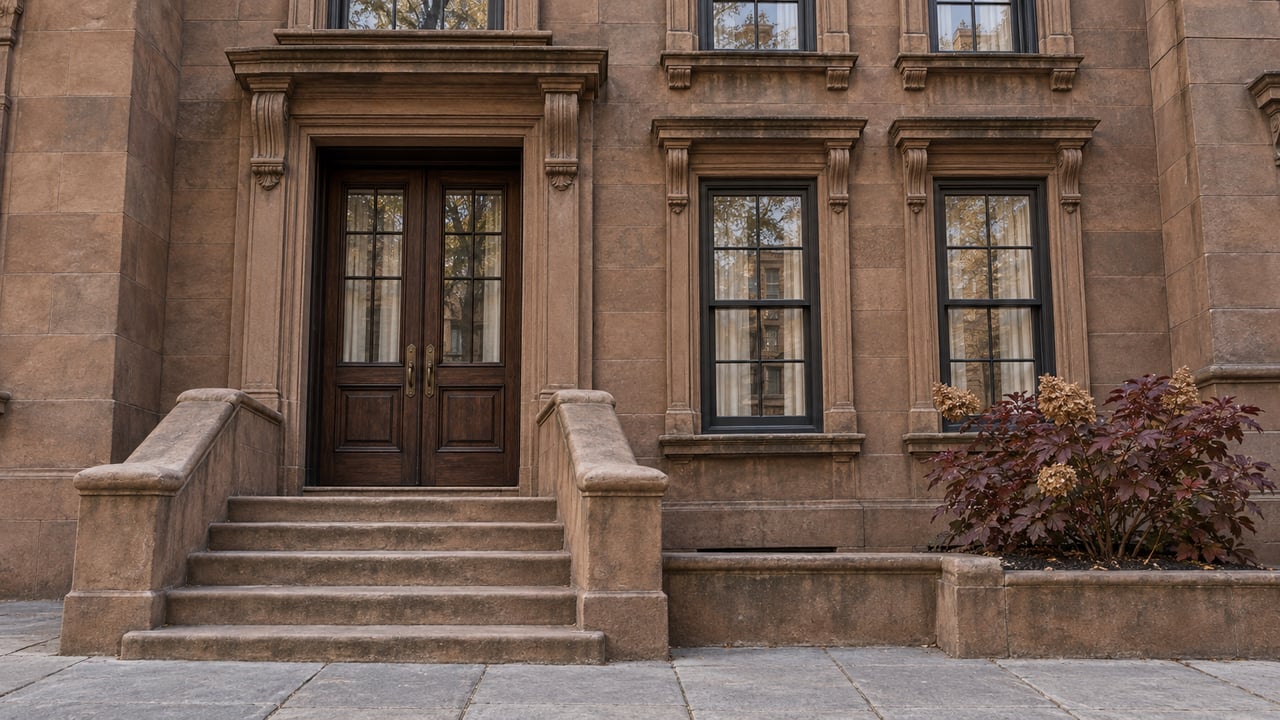
MHNA describes this year's party as a celebration of "the 144th anniversary of the world's first electric Christmas tree lights, first lit right here in Murray Hill." The math holds. In December 1882, Edward H. Johnson, vice president of the Edison Electric Light Company, lit a tree in his townhouse on East 36th Street.
According to Smithsonian magazine, Johnson hand-wired 80 red, white and blue bulbs around the tree and set its trunk on a revolving pedestal. The same article cites W.A. Croffut of the Detroit Post and Tribune, who described the tree as an uncanny spectacle, its eighty glass-encased lights divided about equally among white, red and blue. Patrons of Park Avenue adds that each bulb was roughly the size of a walnut and that an electric motor turned the base, so the tree worked as a holiday display and as a technical demonstration.
The tree makes more sense alongside the rest of the block. Johnson was not the only early adopter in the neighborhood. J. P. Morgan lived a few blocks away, and his Murray Hill mansion served as a private testing ground for Thomas Edison and his team, fitted with generators, wiring and hundreds of incandescent lamps. Because of residents like these, Murray Hill became one of the first residential neighborhoods in New York to be wired for electricity. Before then, Christmas trees were lit with wax candles, which often started fires. A wired tree in a wired neighborhood was a demonstration of what the new system made safe.
The Malls Came From Covering a Railroad Cut
The Park Avenue malls were not part of anyone's original plan. The Commissioners' Plan of 1811 laid out the avenue simply as Fourth Avenue. Starting in the 1830s, the New York and Harlem Railroad ran down the middle of it. Steam locomotives struggled with the grade over Murray Hill, so in 1833 an open rock-cut trench was dug to carry trains as far north as 40th Street.
Neighbors objected to the noise and the danger. By the early 1850s, under pressure from residents and city officials, the railroad covered the trench between 34th and 40th Streets. The surface above was planted as oval boulevard malls, and that stretch of Fourth Avenue was renamed Park Avenue. The rest of Park Avenue took the name later. Fourth Avenue north of Grand Central was renamed in 1888.
So the planted medians where the lightings happen are the oldest part of Park Avenue to carry the name, and they exist because Murray Hill residents pushed to have a railroad covered over.
Who Keeps the Malls Ready for December
The malls declined during the city's fiscal crisis of the 1970s. Iron fences deteriorated, soil compacted and planting beds went largely bare. In the early 1980s, residents, community leaders and Park Avenue building owners organized as Patrons of Park Avenue, which became a committee of the Murray Hill Neighborhood Association. The malls are public property, so the group works with the New York City Department of Parks and Recreation.
Its restoration plan rebuilt the cast-iron fences to their original designs from about 1850, brought back historically appropriate plantings, and set up a year-round seasonal planting and maintenance program. The group also started the rotating sculpture program that has turned the malls into an outdoor gallery.
The association that throws the tree lighting has a committee that tends the ground it is held on. The holiday party belongs to the same civic work the neighborhood does on these blocks all year.
Four Blocks, Walked North
The whole first week of December fits on a short walk along the avenue. Going from south to north:
- Park Avenue and East 35th Street. On Friday, Dec. 4, at 5:30 p.m., Metropolitan Synagogue of Murray Hill holds its public menorah lighting for the first night of Hanukkah. The synagogue has hosted the lighting since 1978 and calls it the first and longest-standing in New York City. A Hanukkah concert and Shabbat services follow from 6 to 7 p.m. at Scandinavia House, 58 Park Avenue. All are welcome, and the synagogue asks guests to RSVP by email through MHNA's announcement.
- East 36th Street, just off the avenue. Johnson's house stood on this street, where the 1882 tree was lit.
- Park Avenue at 37th Street. A historical marker honors Mary Lindley Murray. In September 1776 she is credited with inviting British officers, including William Howe, to stop for refreshments at the Murray home, which slowed their pursuit of Washington's retreating army. The neighborhood takes its name from her family's estate.
- Park Avenue and East 38th Street. On Thursday, Dec. 3, at 6 p.m., MHNA's tree lighting begins outdoors. At 6:30 the party moves inside the Church of Our Saviour at 59 Park Avenue for food and drinks until 8:30. Tickets run from free to $35, and MHNA members attend free. Reserve through the association's event page.
Under these same blocks, the Park Avenue Tunnel between East 33rd and East 40th Streets is still closed. MHNA's Nov. 3 newsletter reports that the rehabilitation began in 2016, was originally due to be finished in January 2019, and as of NYC DOT's Sept. 29 update still needed additional safety work and final inspections. The MHNA update gives no confirmed reopening date and describes construction barriers at both entrances, near East 33rd and East 40th Streets.
Two Blocks West, Morgan's Own Holiday Tradition
J. P. Morgan's name comes up in the electric-light story, and his library carries the season's other long-running tradition. The Morgan Library & Museum, at 225 Madison Avenue at 36th Street, shows Charles Dickens's original 1843 manuscript of A Christmas Carol in J. Pierpont Morgan's Historic Library every holiday season. Last season the display ran from Nov. 25, 2025, through Jan. 11, 2026, open to the page where Scrooge sees Marley's face in the door knocker.
On Tuesday, Dec. 15, Skylark Vocal Ensemble performs its musical version of A Christmas Carol, narrated by Christine Baranski, in Gilder Lehrman Hall from 7 to 8 p.m. Composer Benedict Sheehan's score weaves familiar carols into a text abridged by Skylark artistic director Matthew Guard. Tickets were $110, or $100 for Morgan members. The concert is sold out, and the Morgan's concert page has a waitlist. Ticket holders can view the manuscript from 5:30 to 7 p.m. before the performance.
You can also see the manuscript without a concert ticket. The Morgan's free Friday evenings open the galleries from 5 to 8 p.m. Reservations are required, and tickets become available one week in advance. Friday, Dec. 4, is the night of the menorah lighting at East 35th Street, two blocks east. Book the Morgan's free hours for that night, and the manuscript and the menorah fit into a single evening within a few minutes' walk.
The Week, in Order
- Thursday, Dec. 3, 6 p.m. MHNA Holiday Party & Tree Lighting, Park Avenue and East 38th Street, then indoors at the Church of Our Saviour, 59 Park Avenue, until 8:30.
- Friday, Dec. 4, 5:30 p.m. Metropolitan Synagogue's menorah lighting, Park Avenue and East 35th Street, then a concert and Shabbat services at Scandinavia House, 58 Park Avenue, from 6 to 7.
- Friday evenings, 5 to 8 p.m. Free reserved gallery hours at the Morgan, 225 Madison Avenue.
- Tuesday, Dec. 15, 7 p.m. Skylark and Christine Baranski at the Morgan, sold out with a waitlist, and the manuscript open to ticket holders from 5:30.
A Murray Hill townhouse on these side streets carries its own share of the story told above. Owning one comes with questions about original fabric, later alterations and what a sensitive renovation looks like. If you own a house on one of these blocks and want to understand its history before you make a change or a move, Tom Wexler can help. Work with Tom and get a tailor-made townhouse plan.