How does a neighborhood's median sale price surge toward $1.2 million while its most common home type gets cheaper in the same stretch of months?
That is the puzzle sitting inside Sutton Place's early 2026 numbers. Co-op prices, which make up most of the housing stock in this six-block East Side enclave, were down roughly 13 percent year over year to a median near $775,000. Condo prices, over the same window, surged to a median above $4.5 million. Blend the two and you get a headline number that makes Sutton Place look like it repriced overnight. It didn't. One building did the repricing for it.
The Tower Doing the Math
That building is Sutton Tower, the 62-story condominium at 430 East 58th Street. Designed by Thomas Juul-Hansen and rising 847 feet, it holds 120 corner-exposure residences and is, by most counts, the second-tallest residential building in Midtown East. When enough of its units close in a given reporting period, the neighborhood's blended condo median moves with them, because Sutton Place simply does not have many other condo towers to average against.
The site has a longer history than the tower itself suggests. Years before it topped out, an earlier developer had proposed something closer to 900 feet on the same lot, and a neighborhood group called the East River 50s Alliance fought for a 260-foot height cap across the surrounding blocks. The cap never happened. The tower that eventually rose, at 847 feet, is still the one quietly setting the neighborhood's condo comp sheet in 2026.
Here is what that looks like in the current data, broken out by what actually sold rather than blended together:
| Segment | Early 2026 median | What's actually driving it |
|---|---|---|
| Co-op (most of the housing stock) | ~$775,000 | down ~13% year over year, older inventory repricing |
| Condo | ~$4.5 million+ | closings concentrated at one building, Sutton Tower |
| Neighborhood-wide median (all types blended) | ~$1.2 million | a mix that shifts with whichever type happened to close that quarter |
| True single-family townhouse | too few sales to produce a stable median | concentrated in a handful of historic addresses that rarely change hands |
Average price per square foot across the neighborhood sits near $1,123, which reads as more affordable than comparable stretches of the Upper East Side or Midtown East on paper. That figure is also a blend. It says less about what any specific home costs than it does about which building types happened to trade recently.
The Neighborhood the Tower Doesn't Touch
Sutton Place's actual townhouse inventory sits almost entirely outside this math, because there is so little of it and it trades so rarely that it barely registers as a statistic at all.
The core of it is the Sutton Place Historic District, added to the National Register of Historic Places in 1985. It covers the rowhouses at 1 through 21 Sutton Place and 4 through 16 Sutton Square, twelve contributing houses sharing a communal garden that connects them at the rear. These were built in the 1920s when a small group of society figures, including Anne Harriman Vanderbilt and Anne Morgan, bought up a row of deteriorating riverfront brownstones and rebuilt them as private homes with unobstructed East River views.
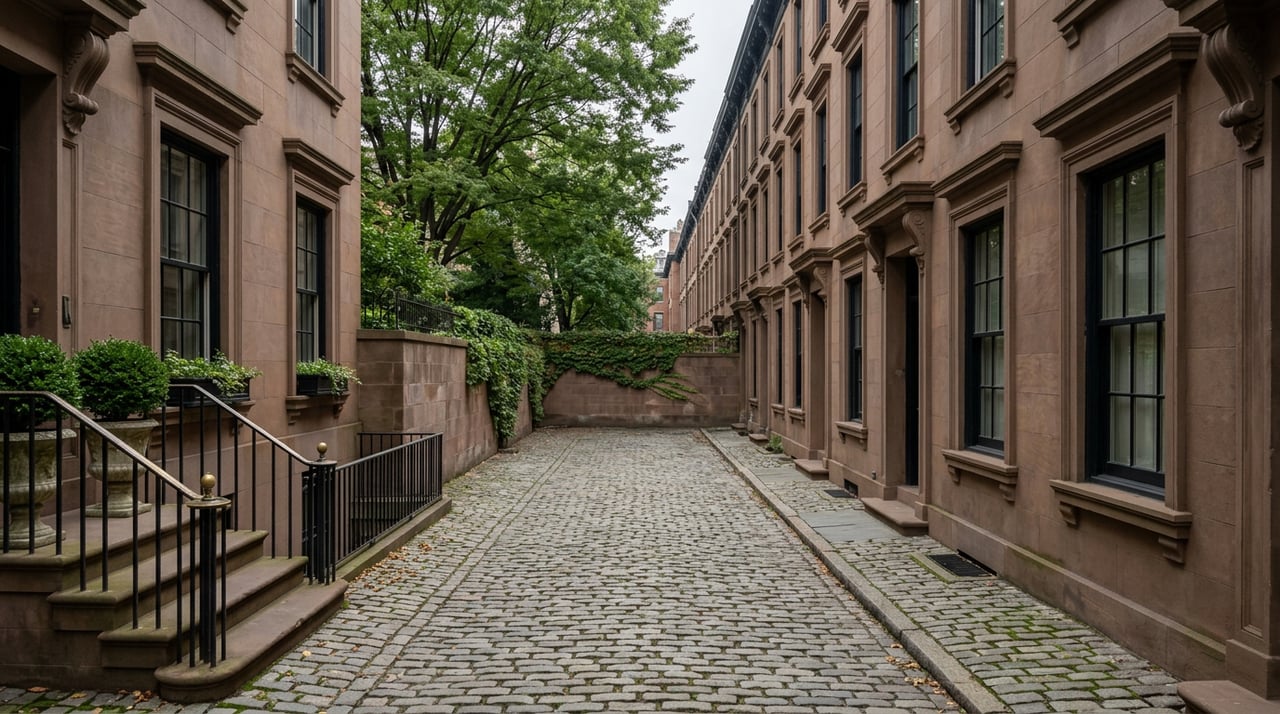
Tucked just off Sutton Square is an even smaller pocket: Riverview Terrace, a private, gated cobblestone street holding just five townhomes. Each has its own dedicated parking space and a key to a shared waterfront garden that most passersby never know exists behind the gate. The architecture critic Paul Goldberger once called it "an enclave of an enclave," which is about as precise a description as the market has ever produced.
Five homes and twelve contributing rowhouses do not generate enough annual turnover to move a median in any meaningful direction. When one does sell, its price gets set against the last comparable sale on that same short street, not against whatever closed last month at Sutton Tower or in a random prewar co-op building three blocks over.
Board Culture Sets the Real Price
Part of why these segments stay so separate on price is that they operate under different rules entirely.
Sutton Place's co-ops, which dominate the unit count in the neighborhood, run conservative boards by design. Down payments of 30 to 50 percent are common, along with substantial post-closing liquidity requirements. Subletting is restricted or prohibited in most buildings, and pied-à-terre use gets evaluated building by building rather than granted as a given. Some of the most established addresses require full-time residency outright.
A new condo tower operates on none of those terms. Financing is simpler, subletting is generally unrestricted, and there is no board interview standing between an accepted offer and a closing. That difference in flexibility, not square footage or finishes alone, explains a meaningful share of the gap between a $775,000 co-op median and a $4.5 million condo median in the same zip code.
It also explains why a renovated two-bedroom co-op with river views in a strong Sutton Place building can trade for $1.5 million to $3 million while a comparable rental runs $6,800 to $7,500 a month, or $82,000 to $90,000 a year. Monthly carrying costs on that same co-op, mortgage, maintenance, and taxes combined, typically land in the $5,500 to $8,000 range. Ownership still pencils against renting here. It just doesn't pencil the way the neighborhood-wide median suggests, because that median is doing double duty for two very different products.
What This Means If You're Comparing Neighborhoods
If you are weighing Sutton Place against another East Side submarket using a single median price or a single price-per-square-foot figure, you are comparing a blend against a blend, and the blend can hide more than it reveals.
The more useful comparison segments by building type before it segments by neighborhood. A Sutton Place co-op should be compared to co-ops of similar vintage and board culture elsewhere on the East Side, not to a supertall condo three avenues over. A Sutton Place townhouse, when one actually comes to market, should be compared to the last sale on the same short street or in the same historic district, because there is rarely a second data point available anywhere else in the neighborhood.
That also means patience matters more here than in markets with deeper inventory. Days on market in Sutton Place have stretched to around 72 in early 2026, which reflects a buyer pool that is well-capitalized and in no particular hurry rather than a market losing interest. For a townhouse specifically, the right approach is less about timing a median and more about having a broker who tracks the Historic District and Riverview Terrace closely enough to know when one of those dozen or so contributing houses is about to move, long before it shows up in any aggregate report.
Frequently Asked Questions
Why don't Sutton Place townhouses show up clearly in market reports? There are too few of them, and they trade too infrequently, to generate a stable median on their own. The reported neighborhood statistics reflect co-op and condo activity almost by default, because that is where the sales volume actually is.
Is Sutton Place genuinely more affordable than the Upper East Side? On a comparable price-per-square-foot basis for similar co-op product, yes, in general. But a straight comparison of neighborhood-wide medians is misleading right now, because Sutton Place's blended figure is being pulled sharply upward by one condo tower's closings in a way the Upper East Side's broader, deeper market is not.
If I'm bidding on a Sutton Place co-op, am I competing with the buyers at Sutton Tower? Almost never. Co-op boards here require substantial down payments, financial vetting, and often primary residency, which draws a different buyer than a new condo with flexible financing and no board interview. The two markets sit blocks apart and rarely compete for the same buyer.
Sutton Place rewards the kind of attention that headline statistics can't provide. If you're evaluating a townhouse here, or trying to figure out what a quoted median actually means for your search, Your Townhouse Guy can walk you through the building-by-building reality behind the numbers. Work with Tom to get a tailor-made townhouse plan built on what's actually for sale, not on what one tower's closing calendar says the neighborhood is worth this quarter.